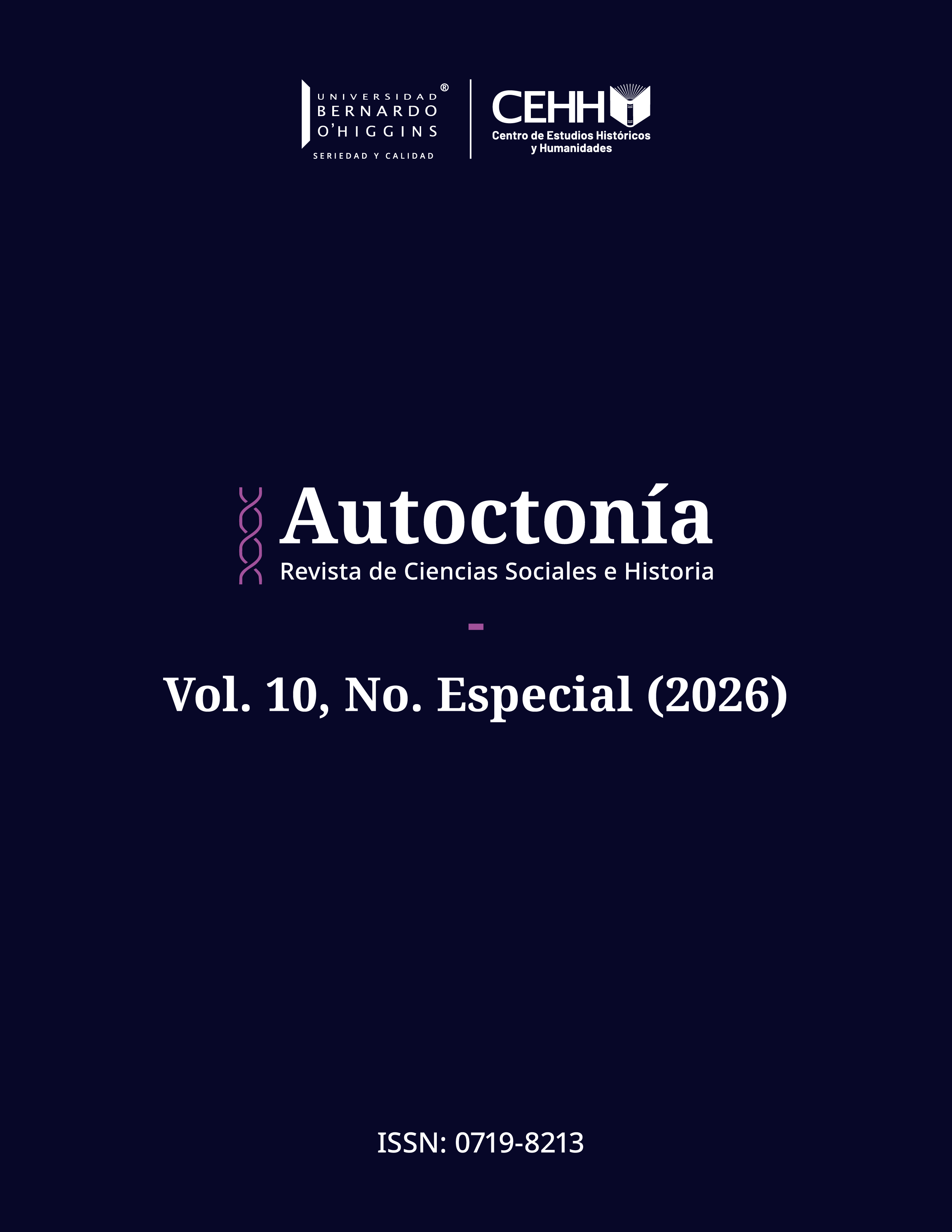
Presentation of the dossier: Latin American Political Economy (2003–2025): Governance, Conflicts, and Structural Transformations
Abstract
Between 2003 and 2025, Latin America experienced profound transformations in its political economy associated with the commodity supercycle, the subsequent economic slowdown, the COVID-19 pandemic, and the acceleration of the global energy transition. This dossier examines these dynamics through the changing relationships among the state, capital, transnational actors, social movements, and structures of inequality across the region. The analysis is organized around five thematic axes: multilevel governance and state capacities; neo-extractivism and disputes over strategic resources in contexts of energy transition; financialization and changes in monetary policy in peripheral economies; the evolution of welfare models, social protection, and inequality; and the expansion of platform-based labor alongside new forms of economic regulation in contexts of political polarization. The dossier brings together eighteen studies based on case studies and documentary analysis aimed at identifying regional patterns and differentiated trajectories. The findings reveal the persistence of dependency structures, the intensification of socio-environmental conflicts, and the emergence of new institutional configurations linked to the energy transition, labor digitalization, and the expansion of financialization. Overall, the dossier provides an integrated interpretation of recent transformations in Latin American political economy, emphasizing structural tensions and new forms of development reconfiguration within contemporary capitalism.
Downloads
References
Acosta, D. y F. Freier (2015): «Turning the immigration policy paradox upside down? Populist liberalism and discursive gaps in South America», International Migration Review, 49(3), pp. 659–696.
Arenas de Mesa, A. (2016): Sistemas de pensiones en América Latina: desafíos y reformas, Santiago, CEPAL.
Arner, D. W., J. Barberis y R. P. Buckley (2017): «FinTech, RegTech, and the reconceptualization of financial regulation», Northwestern Journal of International Law & Business, 37(3), pp. 371–413.
Barrientos, A. (2013): Social assistance in developing countries, Cambridge, Cambridge University Press.
Bebbington, A. y J. Bury (2013): Subterranean struggles: New dynamics of mining, oil, and gas in Latin America, Austin, University of Texas Press.
Blofield, M., J. Pribble y C. Giambruno (2023): The politics of social protection during times of crisis, Cambridge, Cambridge University Press.
Burchardt, H. J. y M. Lang (2019): «Neo-extractivism in Latin America: A new development model?», Journal für Entwicklungspolitik, 35(3), pp. 1–17.
Cecchini, S. y A. Madariaga (2011): Programas de transferencias condicionadas: balance de la experiencia reciente en América Latina y el Caribe, Santiago, CEPAL.
CEPAL (2022): A digital path for sustainable development in Latin America and the Caribbean, Santiago, Comisión Económica para América Latina y el Caribe.
CEPAL (2023): Digital technologies for a new future, Santiago, Comisión Económica para América Latina y el Caribe.
Centeno, M. A., A. Kohli y D. J. Yashar (2017): States in the developing world, Cambridge, Cambridge University Press.
Cimoli, M., G. Dosi y J. E. Stiglitz (2009): Industrial policy and development: The political economy of capabilities accumulation, Oxford, Oxford University Press.
Couldry, N. y U. A. Mejias (2019): The costs of connection: How data is colonizing human life and appropriating it for capitalism, Stanford, Stanford University Press.
de Stefano, V. (2016): «The rise of the ‘just-in-time workforce’: On-demand work, crowdwork, and labor protection in the gig economy», Comparative Labor Law & Policy Journal, 37(3), pp. 471–504.
Dunlap, A., J. Verweijen y C. Tornel (2024): «The political ecologies of ‘green’ extractivism(s): An introduction», Journal of Political Ecology, 31(1), pp. 436–463. https://doi.org/10.2458/jpe.6131
Eaton, K., K. Kaiser y P. Smoke (2011): The political economy of decentralization reforms: Implications for aid effectiveness, Washington, DC, World Bank.
Falleti, T. G. (2010): Decentralization and subnational politics in Latin America, Cambridge, Cambridge University Press.
Ffrench-Davis, R. (2010): Macroeconomía para el desarrollo: desde el financierismo al productivismo, Santiago, CEPAL.
Gudynas, E. (2012): «Estado compensador y nuevos extractivismos», Nueva Sociedad, 237, pp. 128–146.
Gudynas, E. (2015): Extractivismos: ecología, economía y política de un modo de entender el desarrollo y la naturaleza, Cochabamba, CEDIB.
Harvey, D. (2013): A companion to Marx’s Capital, London, Verso.
Hesmondhalgh, D. (2019): The cultural industries, 4ª ed., London, Sage.
Hooghe, L. y G. Marks (2003): «Unraveling the central state, but how? », American Political Science Review, 97(2), pp. 233–243.
Katz, J. (2000): Reformas estructurales, productividad y conducta tecnológica en América Latina, Santiago, CEPAL.
Kenney, M. y J. Zysman (2016): «The rise of the platform economy», Issues in Science and Technology, 32(3), pp. 61–69.
Leff, E. (2014): La apuesta por la vida: imaginación sociológica e imaginarios sociales en los territorios ambientales del sur, México, Siglo XXI.
Levy, S. (2008): Good intentions, bad outcomes: Social policy, informality, and economic growth in Mexico, Washington, DC, Brookings Institution.
Martínez Franzoni, J. y D. Sánchez-Ancochea (2016): The quest for universal social policy in the South, Cambridge, Cambridge University Press.
Mazzucato, M. (2013): The entrepreneurial state, London, Anthem Press.
Ocampo, J. A. (2017): Resetting the international monetary (non)system, Oxford, Oxford University Press.
Peters, B. G. y J. Pierre (2004): «Multi-level governance and democracy», Journal of European Public Policy, 11(1), pp. 75–90.
Prassl, J. (2018): Humans as a service: The promise and perils of work in the gig economy, Oxford, Oxford University Press.
Selwyn, N. (2016): Education and technology: Key issues and debates, London, Bloomsbury.
Soifer, H. D. (2015): State building in Latin America, Cambridge, Cambridge University Press.
Srnicek, N. (2017): Platform capitalism, Cambridge, Polity Press.
Svampa, M. (2013): «‘Consenso de los commodities’ y lenguajes de valoración en América Latina», Nueva Sociedad, 244, pp. 30–46.
Svampa, M. (2019): «Las fronteras del neoextractivismo», Nueva Sociedad, 279, pp. 62–77.
Veen, A., T. Barratt y C. Goods (2020): «Platform-capital’s ‘app-etite’ for control», Work, Employment and Society, 34(3), pp. 388–406.
Zawacki-Richter, O., V. I. Marín, M. Bond y F. Gouverneur (2019): «Systematic review of AI in higher education», International Journal of Educational Technology in Higher Education, 16(39).
Zetzsche, D. A., R. P. Buckley, D. W. Arner y J. N. Barberis (2020): «Decentralized finance», Journal of Financial Regulation, 6(2), pp. 172–195.
Zuboff, S. (2019): The age of surveillance capitalism, New York, PublicAffairs.
Copyright (c) 2026 Yurima Valdivieso Gutiérrez, Alexis Mattheu-Pérez

This work is licensed under a Creative Commons Attribution-NonCommercial-ShareAlike 4.0 International License.
Esta obra está bajo licencia internacional Creative Commons Reconocimiento-NoComercial-CompartirIgual 4.0.